Pet supplies. Shopify for stores where the bowl empties on a regular schedule.








What sets pet supply projects on Shopify apart
Pet food is bought until it runs out, and then bought again. If you sell it online, you need subscriptions with a rhythm per animal, recommendations by species, size and intolerances, complete mandatory feed information and shipping costs that suit heavy packs. We build Shopify Plus setups for exactly that. From the industry, Fred & Felia, EAT SMALL and DoggyBearz work with us, from custom apps and integrations to store and theme adjustments.
What sets a pet supply store apart from other online stores?
Pet food is a consumable with a fixed rhythm. A dog eats every day, so does a cat, and when the bag is empty, the next one has to be there. That makes the industry predictable but also sensitive: deliver late once and you can quickly lose the customer to another store or the supermarket. The store has to make repeat buying easy, not just the first purchase.
At the same time, people are buying for an animal that cannot have a say. They want to know what is in it, whether it is well tolerated and whether it suits age and size. Many animals have intolerances or are fussy eaters. A store that does not answer these questions pushes them into customer service, into returns and into reviews about an untouched bowl.
That is why we start pet supply projects with data and processes: which information does each food need, how do subscriptions and repeat orders work, who ships heavy packs, and are there trade partners alongside end customers? Only then do we decide on page types, apps and custom integrations. That way you avoid rebuilds once the store is live and every change touches running subscriptions.
How do subscriptions and repeat orders work for pet food?
For pet food, a subscription is not an add-on but often the core of the business. The rhythm depends on the animal, though: a large dog empties a bag faster than a small one, and two cats need more than one. A fixed interval for everyone rarely fits. A rhythm that customers can adjust to the amount their animal actually eats works better.
Shopify handles subscriptions through Selling Plans, which subscription apps or custom solutions build on. The details matter: moving a delivery, swapping a flavour, changing the quantity or pausing without cancelling straight away. Each of these actions should be possible in the customer account itself. Otherwise it lands in support as an email, and a small change can quickly turn into a cancellation.
Repeat orders can be supported without a subscription too. If you know the quantity bought and the feeding recommendation, you can roughly estimate when the food will run out and send a timely reminder. Shopify Flow can automate such reminders and follow-up steps. What matters is that the reminder fits the animal and is not sent according to a blanket calendar for all customers.
What should be settled before launching a pet food subscription
- Which delivery rhythms are offered and whether customers can choose them freely
- Whether customers can change flavour, quantity and date in their account themselves
- How subscription discounts interact with tiered prices, bundles and promotions
- What happens when a payment fails or an item is out of stock
- How pausing and cancelling work without annoying customers
How do pet profiles become the basis for recommendations?
Whether a food fits depends on species, size, age, activity and intolerances. This information is the real basis of every recommendation. Once customers have entered it, for example with their first order or in a short questionnaire, the store can show suitable products, quantities and feeding guidance instead of treating every flavour the same.
We set up pet profiles as structured data on the customer account, with a separate entry per animal for households with several pets. On the product side, the matching counterparts sit in metafields: which species, life stage and size a food is meant for and which ingredients it contains or deliberately leaves out. That way profile and range can be matched directly.
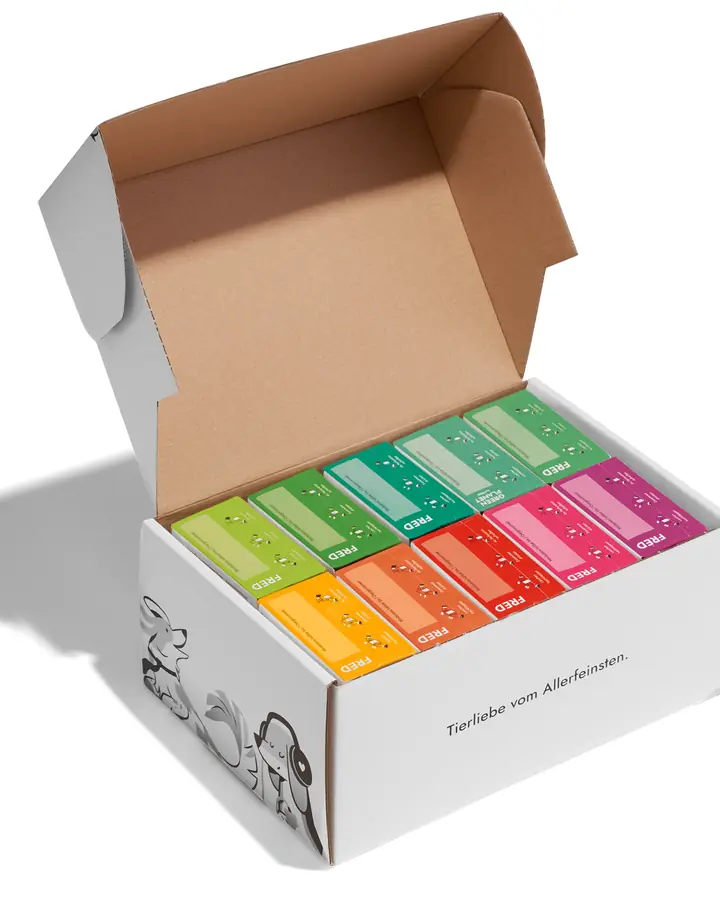
For Fred & Felia, a brand for premium wet food for dogs and cats, we built custom apps and integrations for the Shopify store. As a general rule, standard apps cover the normal case well, but logic around animal, subscription and recommendation is often so specific that a custom solution pays off. We check beforehand what an existing app can already do.
Which mandatory information belongs on a pet food product in the store?
Under EU feed law, pet food is subject to labelling requirements, and this also affects the online store. The information includes, among other things, the type of feed, such as complete or complementary feed, the species, the composition, the analytical constituents, the additives and the feeding instructions. If you sell online, you should show this information before purchase, not only on the packaging.
We set up this information as dedicated metafields rather than running text in the description. That way it looks the same on every product page, is missing less often and can be maintained without touching the layout. Analytical constituents such as crude protein or crude fat become values you can filter by, for example for customers who look for a particular composition.
The legal review of labels stays with the manufacturer and their advisers. Our job is to make sure the store shows the reviewed information completely and correctly. This matters especially with new protein sources, because customers read more closely when an ingredient is unfamiliar. One example of such products is EAT SMALL with dog food made from insect protein, whose Shopify store we adjusted.
How do you build trust without overpromising on health?
Complementary feed for dogs is often advertised with effects, for example for joints, skin, coat or digestion. Caution is needed here. Pet food is not a veterinary medicine, and claims that a food prevents, treats or cures a disease are generally not permitted for it. Which wording works in an individual case is something the manufacturer clarifies with their legal advisers.
For the store this means such claims should be maintained in one place, so a correction does not have to be made separately across many product descriptions, banners and landing pages. That is why we set up claims, target group and feeding recommendation as structured fields. From this segment we know DoggyBearz, a brand for complementary feed for dogs, whose theme we adjusted.
In this industry, trust comes above all from other pet owners. Reviews help more when they mention species, size or age, because customers can then see whether an experience carries over to their own animal. Add to that clear information on origin and production and a customer service team that is easy to reach. If you feature reviews prominently in advertising, watch for health promises there too.
How do you handle heavy packs, trial packs and trade customers?
Dry food often comes in large bags, wet food in boxes full of tins or trays. Weight drives shipping costs, and large packs sometimes need a different carrier or their own packaging. Shipping profiles by weight and tiered prices per pack size make sure customers see on the product page what a delivery costs, and that larger quantities are worth it for them.
Bundles and trial packs lower the barrier to a first purchase, especially with fussy eaters. If customers can test several flavours in small quantities, they do not risk a full box that the animal then refuses to touch. What matters is that stock for the included individual products is tracked correctly and that the path from trial pack to the right flavour on subscription stays short.
Many brands also sell to pet shops and veterinary practices. With B2B on Shopify, trade prices, minimum quantities, payment terms and separate catalogues run in the same store as the consumer business. Vets often need different information from end customers, such as more detailed data on composition. Which products, pack sizes and content each customer group sees should be settled before the build.
What we work on in pet supply projects
Subscriptions and repeat orders
Selling Plans with a delivery rhythm per animal, self-service for flavour, quantity and date in the customer account and repeat-order reminders via Shopify Flow.
Pet profiles and recommendations
Species, size, age and intolerances as structured data on the customer account, matched against product metafields for suitable recommendations.
Feed information as data
Composition, analytical constituents, additives and feeding instructions as dedicated fields, consistent on every product page and usable for filters.
Shipping, tiered prices and bundles
Shipping profiles by weight, tiered prices for large packs and trial packs where stock for the included products is tracked correctly.
Custom apps, integrations and B2B
Custom apps and integrations where standard apps fall short, plus B2B on Shopify for pet shops and vets with their own prices and catalogues.
Clients from pet supplies and pet food
Three clients from the industry we have worked for. No case study on these projects has been published yet. That is why there are deliberately no figures here, only what we delivered for each brand.
Common questions from pet supply projects
Which subscription solution suits pet food?
How do we set up mandatory feed information in the store?
Can we mention health benefits for complementary feed?
How do we deal with high shipping costs for heavy bags?
Can we supply pet shops and vets from the same store?
What have you delivered for pet supply brands?
Related services
Subscriptions, feed data, shipping: talk to us about your store
Tell us what you sell, how your customers reorder and where subscriptions, product data or shipping are still manual work today. We will tell you what belongs in Shopify and where we would start.
This page is based on clients from the industry we have worked for, not on a published case study. That is why there is deliberately no figure here until a case study backs it up.